
GUIDEOccasion & need
Maternity Workwear for Jobs That Require Standing All Day
Standing all day at work while pregnant? Here's what the actual research says — and doesn't say — about workwear, compression, and footwear.
By Mamanida· Published 2026-09-10
In this guide
This is one of the more evidence-dense guides MAMANIDA has published, because it sits closer to occupational health research than styling advice. We've tried to keep every claim traceable to a specific study, and to be explicit about the difference between a large systematic review, a small randomized trial, and a preliminary pilot study — these are not equally strong evidence, even when they point the same direction. Separately, a smaller body of research has tested compression hosiery for leg swelling and symptoms, while preliminary biomechanical studies have examined how footwear configuration affects walking during the third trimester. Results vary by outcome, population, and study design.
What research says about standing occupations during pregnancy
A 2019 systematic review and meta-analysis published in the American Journal of Obstetrics & Gynecology, covering 80 observational studies and more than 850,000 pregnancies, found that prolonged standing at work was associated with increased odds of preterm delivery (odds ratio 1.11, 95% CI 1.02–1.22) and of having a small-for-gestational-age baby (odds ratio 1.17, 95% CI 1.01–1.35); the review characterized much of the underlying evidence as low-to-very-low certainty. A separate 2023 systematic review and meta-analysis of 37 studies found moderate evidence linking several physical occupational demands — high physical workload, long working hours, shift work, and whole-body vibration — to increased preterm birth risk, with pooled odds ratios of 1.44 for long working hours and 1.63 for shift work, both larger than the standing-specific figures above.
It's worth being precise about what this does and doesn't establish. These are observational studies, not controlled experiments — they show an association, not proof that standing itself causes these outcomes for any individual pregnancy, and the confidence intervals for the standing-specific findings sit close to 1 (no effect). This is exactly the kind of finding that belongs in a conversation with a healthcare provider or occupational health service about your specific job and pregnancy, not a determination this article can make for you. What it does establish is that the physical demands of standing occupations during pregnancy are a real, studied variable — which is the reason garment choices for this specific situation are worth researching properly rather than treating as a generic comfort question.
What the research says about compression garments
This is genuinely mixed evidence, and we think it's more useful to show you that than to flatten it into a single recommendation.
On the more cautious side: a 2015 Cochrane review on interventions for varicose veins and leg oedema in pregnancy found no statistically significant difference in lower-leg volume between compression stockings and rest — but that comparison rested on a single small trial involving 35 women. It's therefore useful as a caution against claiming a settled benefit, rather than strong evidence that compression doesn't work; a finding built on one 35-person trial doesn't carry the same weight as a Cochrane synthesis of many larger trials would.
On the more positive side, several individual randomized controlled trials — generally smaller and more recent than the trial in that Cochrane synthesis — have found specific benefits, though it's important not to treat them as one unified body of evidence. A 2001 randomized controlled trial published in the Swiss Medical Weekly (27 treated participants, 15 controls) found that compression stockings did not significantly prevent the emergence of new superficial varicose veins during pregnancy, but did significantly reduce venous reflux at the sapheno-femoral junction and improve self-reported leg symptoms (pain, discomfort, cramps) compared with controls. A 2022 randomized controlled trial published in the Jornal Vascular Brasileiro (60 pregnant women) found a significantly smaller increase in calf and ankle diameter over the course of pregnancy in the group wearing compression stockings compared to controls, alongside a positive subjective experience of wearing them.
Separately, a randomized crossover trial in 108 hairdressers — a genuinely comparable standing occupation, but not a pregnant population — found that low-strength compression hosiery (15–20 mmHg) reduced a combined pain-and-swelling symptom score by 12% and reduced average lower-leg volume by 19 mL, both statistically significant, over a full day of standing work. The pregnancy trials and the hairdresser trial answer slightly different questions: the pregnancy-specific studies provide some evidence for effects on leg swelling and symptoms during pregnancy specifically, while the hairdresser trial shows that low-strength compression can reduce occupational leg symptoms and leg-volume increase during prolonged standing in a non-pregnant working population.
Taken together, the evidence does not support a claim that compression garments are a proven, universal fix for pregnancy-related leg swelling. It does support narrower conclusions: pregnancy trials have reported reductions in lower-leg swelling or symptoms with compression, while a separate occupational trial found reductions in leg symptoms and lower-leg volume during prolonged standing in non-pregnant hairdressers. We did not find a trial directly testing compression hosiery in pregnant workers standing all day.
What the research says about footwear
Footwear research specific to pregnancy is smaller in volume than the occupational-standing or compression literature, and mostly consists of small biomechanical studies rather than large trials — worth knowing before treating any single finding as definitive.
A 2024 pilot study published in the journal Bioengineering used musculoskeletal modeling to compare gait biomechanics across four heel heights (0mm, 15mm, 30mm, and 45mm) in five third-trimester participants, and found that a 15mm heel height produced the most favorable combination of reduced muscle forces and joint torques among the heights tested. A separate study in the third trimester (16 participants) examined how a shoe's heel-to-toe drop affects gait, finding that walking speed and step length changed measurably with different heel-toe drop configurations. Both studies are small and explicitly describe themselves as preliminary — useful for identifying a direction (a modest heel appears to change load distribution favorably compared to completely flat or higher options) rather than a definitive number.
Separately from pregnancy-specific research, a small qualitative study of 14 workers in prolonged-standing environments found that comfort, cushioning, support, fit, grip, and suitability for the work environment were the footwear characteristics workers themselves considered important, though the authors describe the research as exploratory with limited generalizability. This isn't pregnancy-specific, so it shouldn't be treated as evidence of a pregnancy-specific benefit — it does, however, identify practical footwear characteristics that workers in standing occupations report valuing.
What the research doesn't tell us
We found research on occupational standing during pregnancy, compression hosiery, and pregnancy gait biomechanics. We did not find evidence that a particular maternity trouser, dress, waistband, or fabric reduces the pregnancy risks associated with prolonged standing. Those clothing choices should be treated as questions of fit, movement, workplace requirements, and personal comfort — not as medical interventions. The research above tells you why standing work during pregnancy is worth taking seriously and what's been tested in two specific, narrow categories (compression legwear and footwear). It doesn't extend to trousers, dresses, uniforms, or fabric choice, and we're not going to imply otherwise just because this is a workwear guide.
What to look for in maternity clothes for a standing job
Since research doesn't establish a particular maternity trouser, dress, or fabric as medically better for prolonged standing, the useful questions here are practical rather than clinical: can you move comfortably through the tasks your job actually requires, does the waistband stay comfortable through a full shift, does the garment work with any footwear or PPE your role requires, and can it handle the laundering frequency your job demands? A few job-specific considerations worth thinking through:
Range of movement — bending, reaching, or crouching repeatedly needs a different cut than a role spent mostly walking or standing still; a rigid waistband or a skirt with limited stretch can become a genuine daily friction point in physically active standing roles.
Adjustable waist construction — a waistband that can flex across both a full shift and the weeks of pregnancy is a practical advantage regardless of what the research says about standing itself; see MAMANIDA's guide on over-bump vs. under-bump construction for the trade-offs between styles.
Uniform and dress-code compatibility — many standing jobs (retail, healthcare, hospitality) have specific uniform or PPE requirements; a maternity-adapted uniform piece that doesn't sit correctly under required outerwear or safety equipment isn't solving the actual problem.
Temperature and layering — standing jobs vary enormously in climate (a stockroom versus a shop floor versus a kitchen), and a capsule of layerable pieces tends to handle that variation better than a single-weight wardrobe.
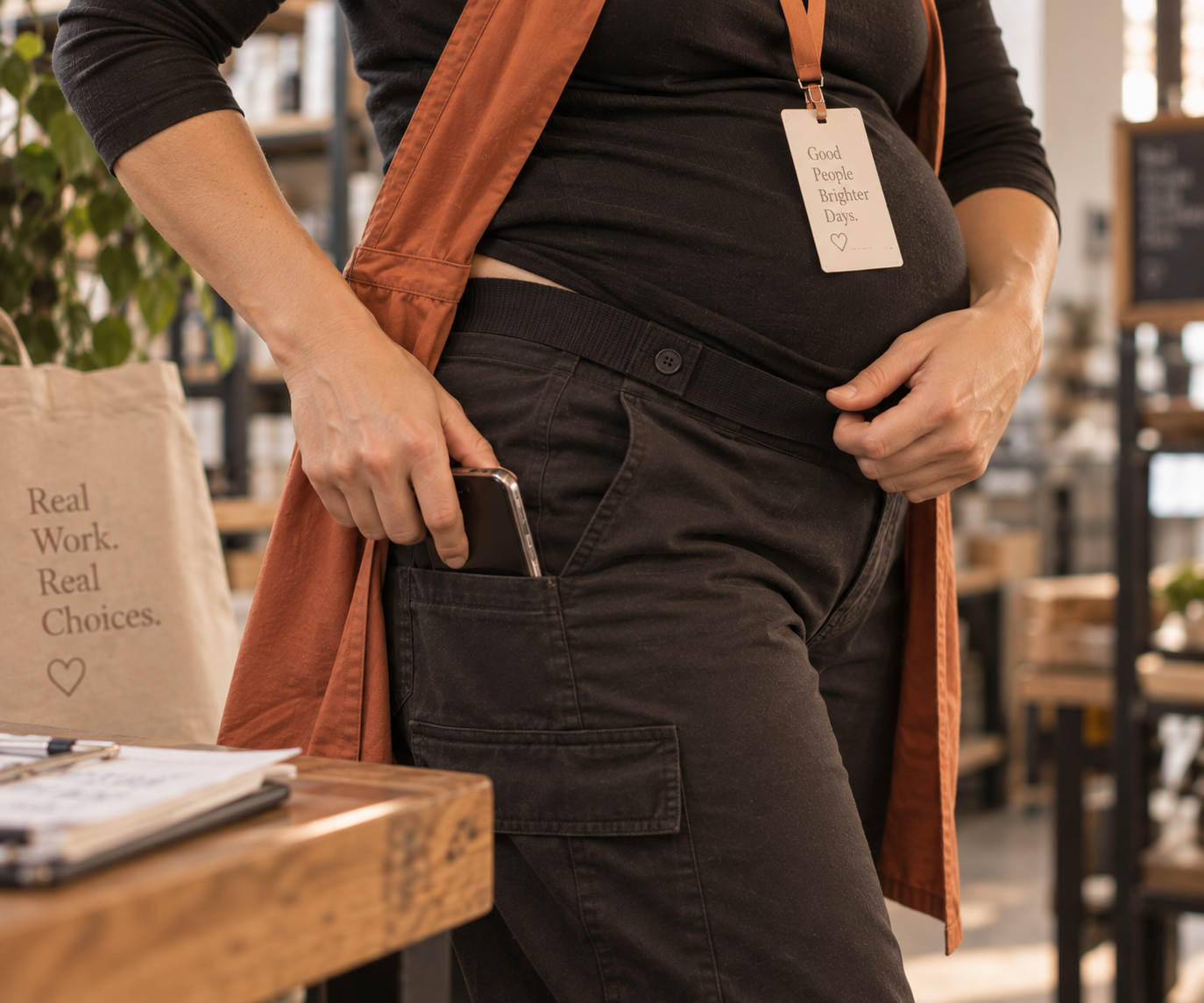
Pockets and practical storage — a genuinely minor detail that matters disproportionately in jobs where you're on your feet and can't easily set a bag down.
Laundering frequency — if a garment is likely to be washed after every shift, check its care requirements, drying time, and whether those requirements are practical for your working week.
What this means for choosing workwear
Translating this research into shopping guidance, rather than medical guidance, gives a few defensible starting points:
Graduated compression legwear has trial-level evidence for reducing measurable lower-leg swelling and improving self-reported symptoms during extended standing, drawing on evidence from both pregnant and non-pregnant standing populations. It is not proven to prevent varicose veins from developing in the first place.
Heel height may affect third-trimester gait biomechanics. One five-person pilot found a 15mm heel performed most favorably overall among four tested heights, while a separate 16-person study found that heel-to-toe drop altered gait parameters including walking speed and step length. These findings are preliminary and aren't sufficient to establish a universal heel height for pregnancy work shoes.
Fit, cushioning, support, and workplace suitability are recurring priorities reported by workers in prolonged-standing occupations, although the study behind this finding was small, qualitative, and not pregnancy-specific.
None of this substitutes for a conversation about your specific job. Many workplaces have occupational health or risk-assessment processes specifically for pregnancy; if standing demands are a genuine concern for your role, that's a reasonable and normal thing to raise with a healthcare provider or your employer's occupational health resource, separate from what clothing you choose to wear.
Comparing workwear on MAMANIDA
You can compare maternity workwear pieces — trousers, dresses, and layering pieces suited to an active or standing role — across brands on MAMANIDA, filtering by price, size, and construction details like waistband type and stretch. Where compression legwear or specific footwear features are relevant to your role, the research above should help you judge which claims are actually backed by evidence and which aren't.
Sources referenced
Palmer KT et al. — “The impact of occupational activities during pregnancy on pregnancy outcomes: a systematic review and meta-analysis,” American Journal of Obstetrics & Gynecology, 2019 (pubmed.ncbi.nlm.nih.gov/31550447) · “Maternal Occupational Risk Factors and Preterm Birth: A Systematic Review and Meta-Analysis,” 2023 (ncbi.nlm.nih.gov/pmc/articles/PMC10625911) · Bamigboye AA & Smyth RM — “Interventions for varicose veins and leg oedema in pregnancy,” Cochrane Database of Systematic Reviews (cochranelibrary.com/cdsr/doi/10.1002/14651858.CD001066.pub3) · “Compression stockings prophylaxis of emergent varicose veins in pregnancy,” Swiss Medical Weekly, 2001 (pubmed.ncbi.nlm.nih.gov/11835115) · Saliba-Júnior OA et al. — “Positive perception and efficacy of compression stockings for prevention of lower limb edema in pregnant women,” Jornal Vascular Brasileiro, 2022 (pmc.ncbi.nlm.nih.gov/articles/PMC8958436) · Blazek C et al. — “Compression hosiery for occupational leg symptoms and leg volume: a randomized crossover trial in a cohort of hairdressers,” Phlebology, 2013 · “Suitable Heel Height, a Potential Method for Musculoskeletal Problems during the Third Trimester: A Pilot Study,” Bioengineering, 2024 (pmc.ncbi.nlm.nih.gov/articles/PMC11274345) · “The Influence of a Shoe's Heel-Toe Drop on Gait Parameters during the Third Trimester of Pregnancy” (pmc.ncbi.nlm.nih.gov/articles/PMC9220068) · “An explorative qualitative study to determine the footwear needs of workers in standing environments” (ncbi.nlm.nih.gov/pmc/articles/PMC5577656)
Related guides
Understanding Elastane in Maternity Clothing
The percentage on the label tells you less than you might think. The same elastane percentage can behave completely differently depending on the fibres, fabric structure, and construction around it.

How to Build a Maternity Capsule Wardrobe
A maternity capsule wardrobe is a small set of pieces, chosen to work together, that covers most of what pregnancy actually requires without buying a full new wardrobe for a body that keeps changing.
MAMANIDA may earn a commission when you visit or purchase from a retailer through certain links. This does not affect the price you pay or how we evaluate products. Full disclosure available separately. This guide summarizes peer-reviewed and Cochrane systematic-review research as cited above. It is not medical advice, does not replace individualized guidance from a healthcare provider or occupational health professional, and does not represent claims of physical product testing by MAMANIDA. Study findings described as "associated with" reflect observational or trial-level evidence, not proof of cause and effect for any individual. If you have concerns about the physical demands of your job during pregnancy, please raise them with a healthcare provider or your employer's occupational health resource.