INVESTIGATIONFit & construction
How Maternity Sizing Actually Works — and Why the Same Size Can Fit Differently Across Brands
We checked 31 brands' actual size charts to see how much "Medium" really varies — and found that the answer depends on which measurements a brand chooses to size around in the first place.
By the Mamanida research team· Published 2026-09-11
In this guide
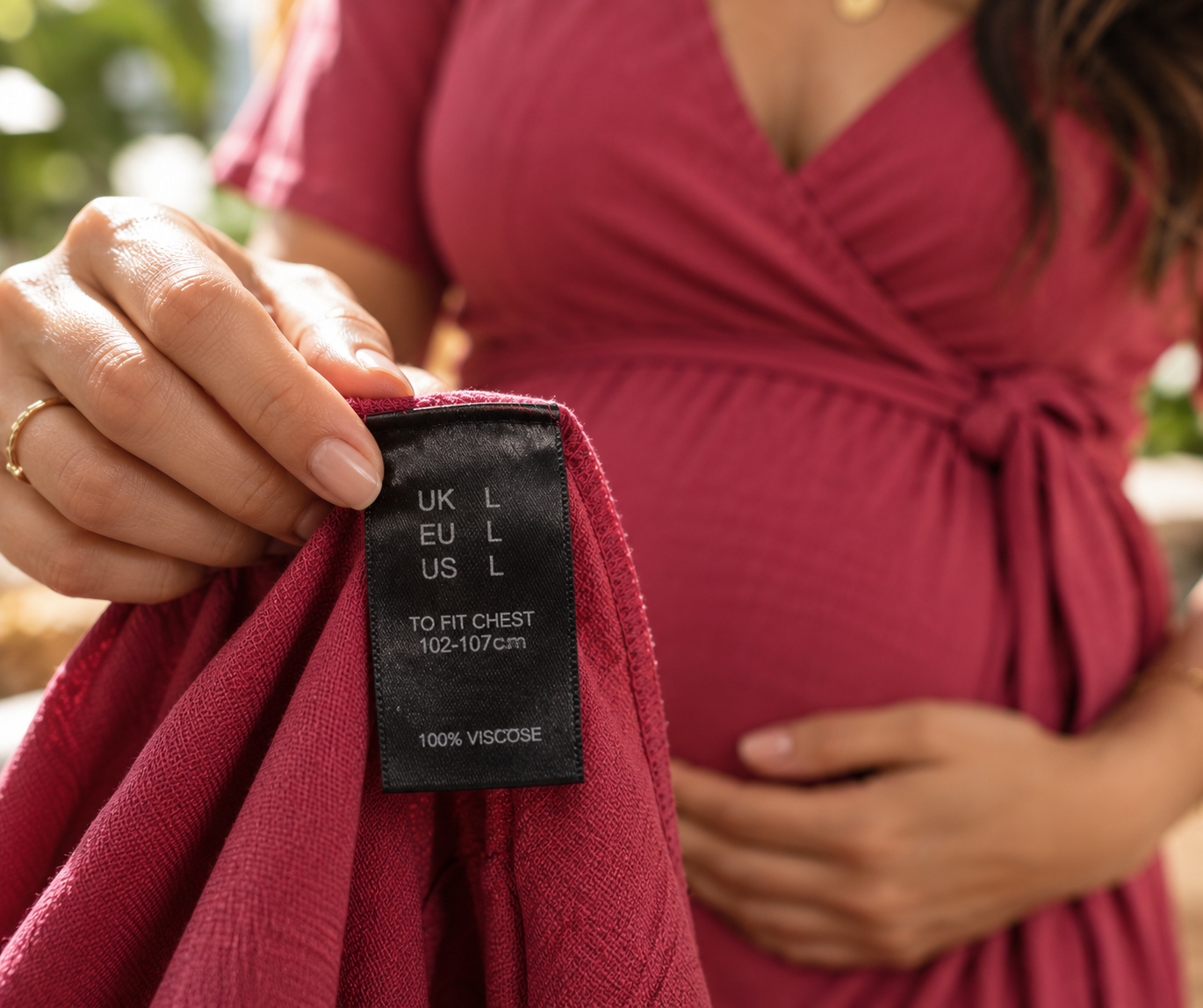
If you've ever bought a "medium" from one maternity brand and a "medium" from another and found that they fit nothing alike, you're not imagining it. There's a real, research-based explanation for why maternity sizing can be difficult to predict — and understanding it can save you the frustration of assuming the problem is your body rather than the label.
Even one sizing system struggles to fit one body consistently
Here's a finding that might surprise you: even within a single conventional sizing system, one woman's measurements often don't line up neatly with one size. A 2025 study published in Scientific Reports, a peer-reviewed journal from the Nature publishing group, used 3D body scans of 677 women and classified each of them using the UK Alvanon sizing system. The result: only 9.15% of the women had bust, waist, and hip measurements that all fell into the same size category. For the other 90.84%, at least one of those three measurements fell into a different size category — and 35.45% of participants weren't accommodated by the Alvanon sizing scheme at all.
That's not a maternity-specific problem — these were general body measurements, not measurements of pregnant bodies. It's a reminder that a single size category is an approximation — not a guarantee that every relevant body measurement will fall neatly within the same category. Add pregnancy to the equation, and that approximation gets stretched even further.
Pregnancy changes your body unevenly, not all at once
A 2020 study in the International Journal of Fashion Design, Technology and Education followed 20 pregnant women using repeated 3D body scans from week 6 through week 39 of pregnancy. On average, their measurements increased by 2.7 in. (6.9 cm) at the bust, 8.8 in. (22.4 cm) at the waist, and 3.3 in. (8.4 cm) at the hips. The important point isn't that every pregnant body will change by those exact amounts — the study included only 20 participants — but that the measured dimensions changed by substantially different amounts from one another. That makes proportional size grading a poor description of how pregnancy-related changes in body shape actually happen. A related 3D-scanning study similarly found that body and pattern changes during pregnancy did not increase proportionally.
This helps explain why the same maternity garment may not feel or fit the same way throughout pregnancy: the body dimensions that matter for that particular garment may be changing by different amounts.
A maternity sizing standard exists — brands just aren't required to use it
It's easy to assume that maternity sizing feels chaotic because there's no rulebook at all. That's not quite true. ASTM International publishes D7197/D7197M-21, a body-measurement table specifically for misses maternity sizes 2 through 22, designed to help manufacturers develop garments around actual pregnant body measurements. A general body-sizing framework, ISO 8559, also exists, although it isn't maternity-specific and, in its own wording, leaves garment measurements and design ease "normally determined by the designer and manufacturers."
That last point is the real story. Standards exist, but nothing requires every brand to adopt them or interpret them in the same way if they do. Several maternity brands we checked tell shoppers to start with their pre-pregnancy size. But brands can use different size charts, pattern shapes, grading systems, garment ease, fabrics, and construction methods, so the same nominal starting size doesn't guarantee the same finished fit.
What MAMANIDA found across 31 brands
To see what this looks like in real-world maternity shopping, we reviewed the published sizing guidance of 31 brands represented on MAMANIDA in September 2026.
Not every brand could be compared numerically. Six had no official published size chart we could locate, several published guidance without an extractable numerical table, and GLAMIX uses product-specific charts rather than one universal chart. We limited the direct measurement comparison to nine brands with a sizing band described as "Medium" or its direct equivalent and sufficiently complete numeric measurements for comparison. For eight of those brands, the figures came directly from first-party size charts. For brands using a proprietary numbering system rather than a letter size, we used only the brand's own stated cross-reference to "Medium" or its equivalent (Isabella Oliver's own UK 12–14 mapping and Légoe Heritage's own size 2 mapping), rather than imposing an external UK/US/EU conversion that the brand itself doesn't state. For the ninth brand, AIM'N, its numeric table couldn't be reliably extracted from its own site, so we cross-checked its figures against two independent retailer reproductions of the AIM'N chart instead — a secondary-source verification, not first-party.
Among the eight first-party brands, the midpoint of the published bust measurement at that size ranged from approximately 92 cm to 100.3 cm, while hip midpoints ranged from approximately 97.8 cm to 106 cm. Adding AIM'N's secondary-sourced figures extends the upper end for the hips to approximately 108 cm — an important distinction, since that highest endpoint is based on retailer reproductions rather than AIM'N's own published table.
The charts weren't all trying to describe pregnancy in the same way, either. HATCH's chart explicitly includes a waist measurement taken over the belly at its widest point, while Légoe Heritage and Ingrid & Isabel omit a waist measurement from their sizing guidance entirely. PinkBlush publishes bust and hip measurements but tells shoppers the waist "will stretch to accommodate growing belly" rather than assigning it a number. Isabella Oliver sizes according to pre-pregnancy body measurements rather than the pregnant body itself.
So the difference isn't simply that one brand's Medium is "bigger" than another's. Brands can define the sizing problem differently in the first place — deciding which measurements matter, which measurements to size for, and which to treat as fixed versus elastic.
There's also an important limitation to the comparison: some of these nine charts are maternity-specific, while others (Beyond Yoga, AIM'N) apply a regular or activewear chart to maternity pieces. HATCH's bump-inclusive chart, in particular, isn't measuring the same thing as a chart based on pre-pregnancy body size. These figures therefore illustrate how much published sizing guidance can vary — they aren't a ranking of which brand fits better, and a brand outside this nine-brand comparison isn't assumed to be more or less consistent than the brands included here.
What shoppers actually describe
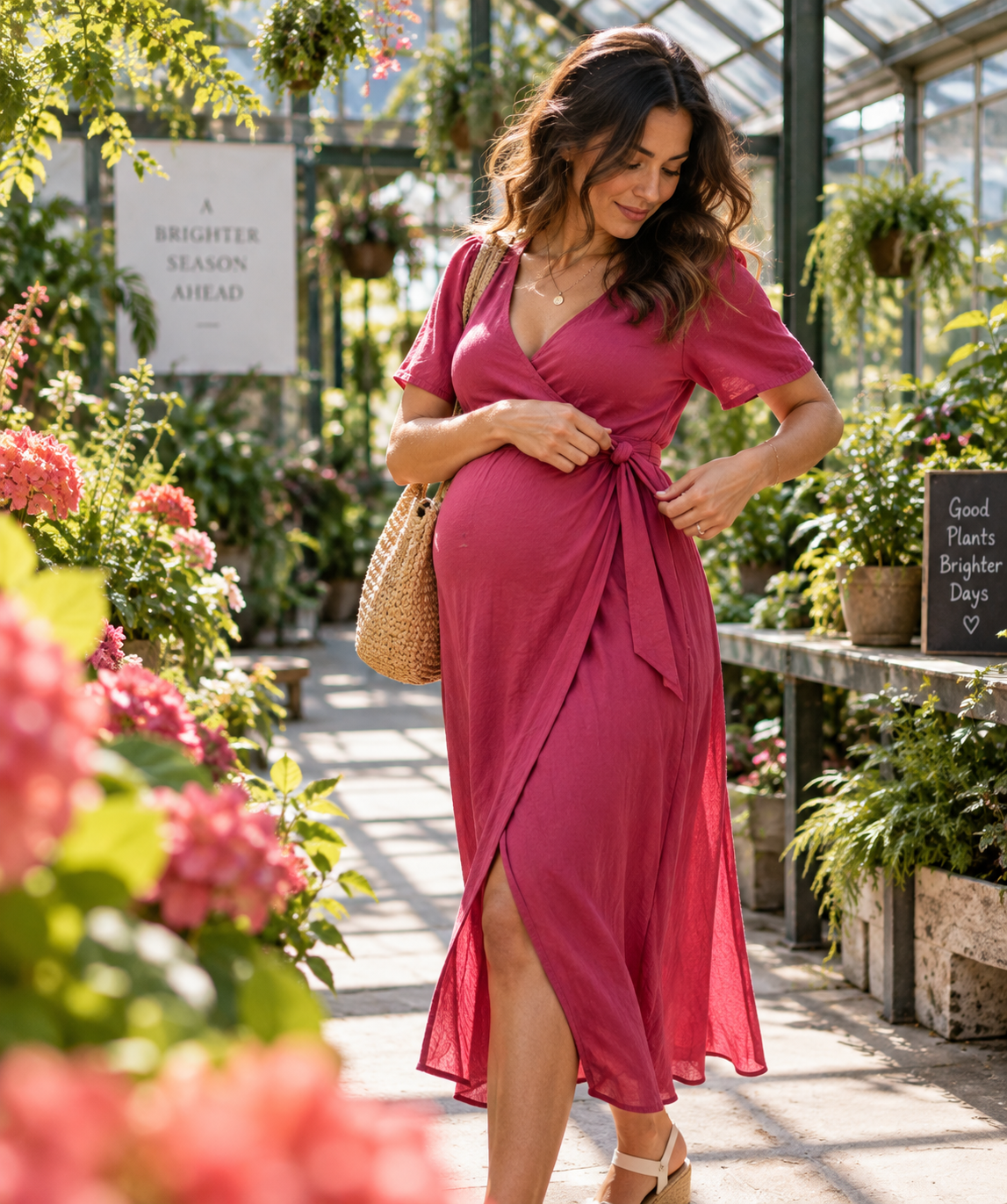
Individual shopper accounts illustrate what uncertainty around maternity sizing can look like in practice. Writing on The Bump's community forums, one shopper described herself as having been "a solid medium all my life" but found a medium from a maternity brand far too tight despite having gained only a few pounds at that point. On Mumsnet, a shopper who described herself as "a very standard size 10, not vanity sized" found that even a size 16 in one brand's maternity jeans wouldn't fit over her thighs. A Trustpilot review of Seraphine described buying the same size from the same brand during two different pregnancies — "smaller size is too small and the same size is too big — bizarre!"
These accounts can't tell us how common maternity sizing problems are or establish that any particular brand consistently runs large or small. They simply illustrate the kinds of fit mismatches individual shoppers report encountering.
What this actually means when you're shopping
Treat your pre-pregnancy size as a reasonable starting point — not a guarantee. Before buying, check the brand's current measurement chart rather than assuming your usual letter or number size will translate directly. Use the brand's published range itself to choose your size, not the midpoints referenced above — those midpoints are used only to compare charts consistently with one another, and being above a midpoint doesn't mean you're outside the brand's actual size range. Pay attention to construction too: stretch panels, adjustable waistbands, wrap construction, and rigid fixed waistbands accommodate changes in fit differently. When a brand provides actual garment measurements, use those alongside its body-size chart rather than relying only on the letter or number printed on the tag.
Comparing maternity sizing on MAMANIDA
Because sizing can vary so much between brands, comparing actual measurements and construction details — not just size labels — is one of the most useful things you can do before buying. On MAMANIDA, you can compare maternity pieces across brands by size, price, and construction, helping you evaluate the garment itself rather than guessing from the label alone.
Sources referenced
- Alhassawi, R., Gill, S., Hayes, S., & Brubacher, K. (2025), "Evaluating machine learning models for clothing size prediction using anthropometric measurements from 3D body scanning," Scientific Reports, 15, Article 40781 (nature.com)
- Balasubramanian, M., & Robinette, K. (2020), "Longitudinal anthropometric changes of pregnant women: dynamics and prediction," International Journal of Fashion Design, Technology and Education, 13(3) (tandfonline.com)
- Sohn, M., & Bye, E. (2012), "Visual analysis of body shape changes during pregnancy," International Journal of Fashion Design, Technology and Education, 5(2) (tandfonline.com)
- ASTM D7197/D7197M-21, "Standard Table of Body Measurements for Misses Maternity Sizes Two to Twenty-Two" (store.astm.org)
- ISO 8559-2:2025, "Size designation of clothes — Part 2: Primary and secondary dimension indicators" (iso.org)
- The Bump Community forum thread (forums.thebump.com)
- Mumsnet forum thread (mumsnet.com)
- Trustpilot, Seraphine reviews (uk.trustpilot.com)
MAMANIDA 31-brand sizing audit — brand size charts checked (September 2026) PinkBlush (pinkblushmaternity.com) · Isabella Oliver (isabellaoliver.com) · Ingrid & Isabel (ingridandisabel.com) · HATCH Collection (hatchcollection.com) · Kindred Bravely (kindredbravely.com) · Bumpsuit (bumpsuit.com) · Légoe Heritage (legoeheritage.com) · Beyond Yoga (beyondyoga.com) · AIM'N (figures confirmed via two independent third-party retailer chart mirrors — Dancewear Centre and Prae Wellness — after AIM'N's own numeric table could not be directly extracted). The full 31-brand review, including brands excluded from numeric comparison and why, is available on request.
Related guides
How to Choose Maternity Jeans for Every Trimester
What matters most in maternity jeans can change as your pregnancy progresses.
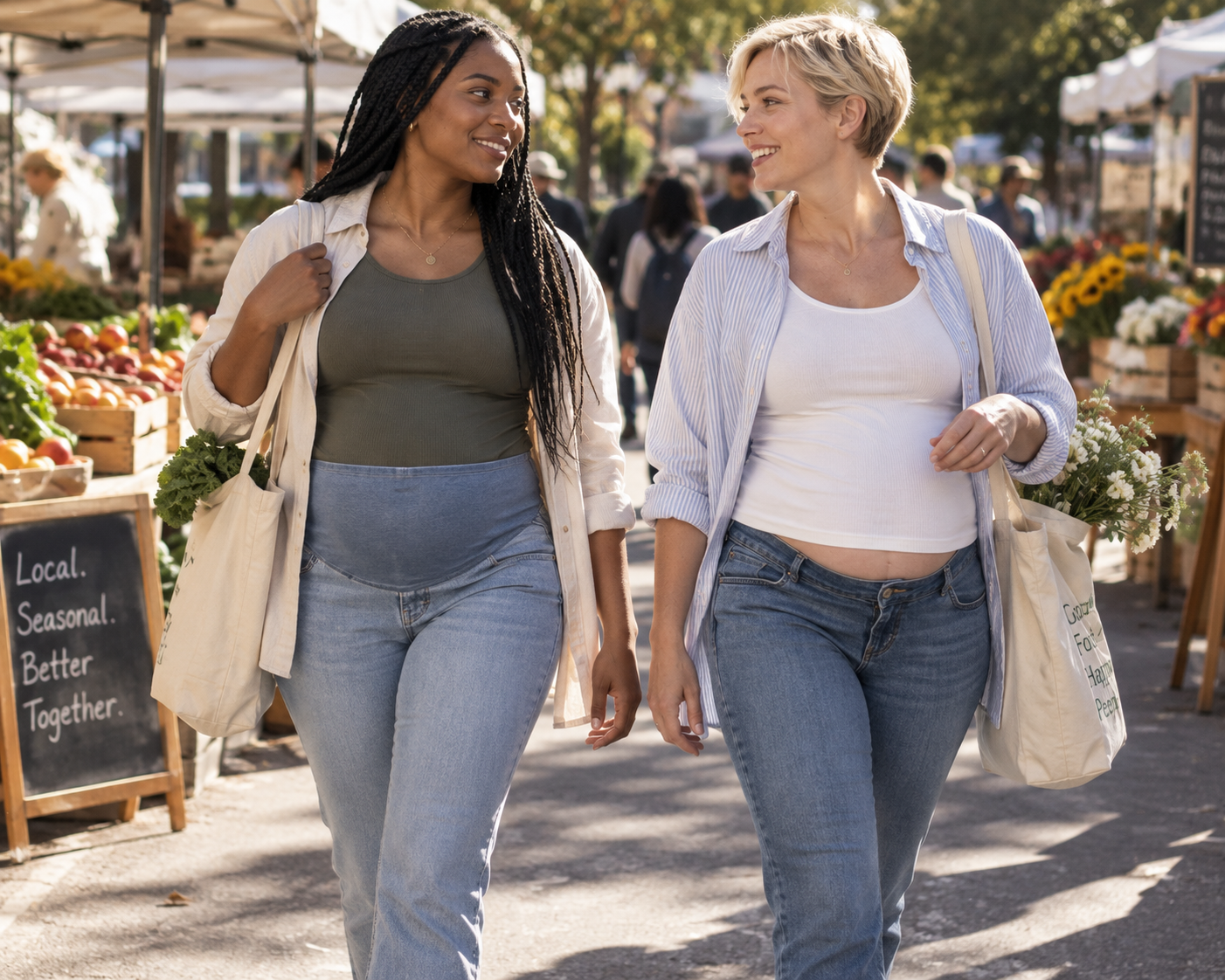
Over-Bump vs Under-Bump Maternity Jeans: What's the Difference?
The difference comes down to where the waistband sits relative to the bump.
How to Build a Maternity Capsule Wardrobe
A maternity capsule wardrobe is a small set of pieces, chosen to work together, that covers most of what pregnancy actually requires without buying a full new wardrobe for a body that keeps changing.
MAMANIDA may earn a commission when you visit or purchase from a retailer through certain links. This does not affect the price you pay or how we evaluate products. Full disclosure available separately. This guide draws on peer-reviewed research, published industry standards, and publicly posted consumer reviews and forum posts, as cited above. Consumer accounts are individual experiences, not evidence of prevalence. This does not represent claims of physical product testing by MAMANIDA, and individual fit varies by body, brand, and garment.